Beryl
from the Antique Jewelry University
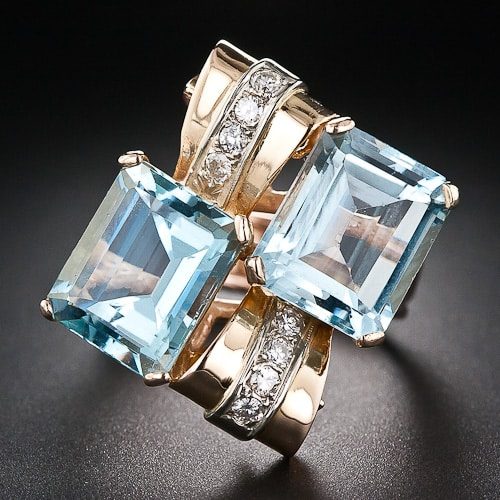
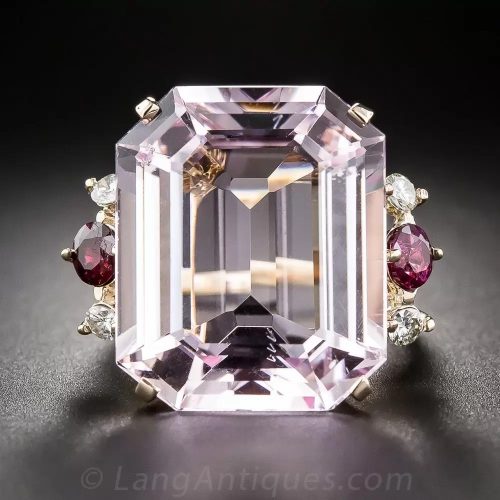
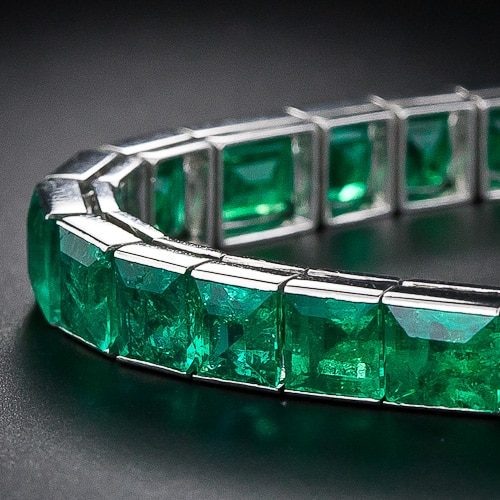
Beryl is a mineral family with a wide variety of colors, ranging from blue to red. The colors are produced by minor traces of elements in the - beryllium silicate - crystal lattice and when these are absent, the mineral will be colorless. The two most important gemstones in this group are emerald and aquamarine. The rare red variety is named bixite, the yellow one is named heliodore, a pink variety is known under the name morganite and the colorless beryl is named goshenite. There is also a rare pale green member with a golden flash and this stone is marketed under the name riesling beryl. Two other blue beryls are known as maxixe and true blue, although the latter can be considered as aquamarine with a very high iron content.
Beryls are found around the world in beds of granitic pegmatite. Goshenite is usually formed in gaseous cavities in granite where transition metals are not able to diffuse into the crystals. Most members of the beryl family are very durable with the exception of emerald, which is brittle. Sometimes beryls are found which show asterism or chatoyancy. A nice novelty is the trapiche formation in some emerald. A 211 carat cat's-eye beryl is on display at the Los Angeles County Museum, along with a star beryl of over 11 carats.
Beryl's name is derived from the Greek word beryllus and this group was widely know in the ancient worlds. The word beryllus was used originally for any green stone and was later assigned to the beryl family as we know it today. The mystical powers of beryl and its transparency made it a medium for seeing the future and predicting things to come. An elixer of water in which beryl was dipped, was used by the ancient Greeks to cure bladder infections and kidney stones. A medieval cure for asthma also involved this gemstone and the physcians of the middle ages believed that beryl was a remedy against liver disease and jandice. A beryl with a frog glyptograph could turn opponents into friends and when carved with a bird, the spirit of a deceased person could be invoked.
The metaphysical powers of beryl are many and it is the gemstone of the crown chakra. Some credits given to this gemstone family are a cure against nausea, obesity, ulcers and seasickness. Another attribute of beryl is the increased defense against toxins and pollutants.
Several beryls - in particular emerald and aquamarine - are used as anniversary gifts as well as birthstones.
| Gemological information for beryl | |
|---|---|
| Color | Red, pink, yellow, green, blue and colorless. |
| Crystal structure | Hexagonal |
| Refractive index | 1.577-1.583 |
| Family | Beryl |
| Durability | Excellent (emerald is brittle) |
| Hardness | 7.5-8 |
| Similar stones | Beryl can be confused by appearance by a number of stones, as quartz, glass and zircon |
| Treatments | Heat treatment, oiling, waxing |
| Country of origin | Beryl is found worldwide, most notably in Argentina, Afghanistan, Africa, India, United States and Brazil |
| Beryl care | |
| Ultrasonic cleaning | Not safe |
| Steam cleaning | Not safe |
| Warm soapy water | Safe with a soft brush (emerald may be risky) |
| Chemical attact | Usually none (emerald may be risky) |
| Light sensitivity | May fade |
| Heat sensitivity | Not safe |
Online G&G articles on beryl
- July-Aug. 1935, Maxixe beryl, p. 294, 1p.
- Summer 1949, 40 lbs. of beryl found in pocket, Brazil, p. 194, 1p.
- Fall 1950, A 2,000 ct. aquamarine from Brazil, p. 351, 1p.
- Summer 1954, Inclusions in a Madagascan yellow Beryl, by Webster, p. 60, 3pp.
- Fall 1955, A Golden Beryl Cat's-Eye, p. 197, 2pp.
- Fall 1955, Aquamarine Cat's-Eye, p. 198, 2pp.
- Fall 1955, Star Beryl, p. 199, 1p.
- Winter 1964, A 15.4 lb. and a 74.65 lb. Brazilian aquamarine, p. 239, 3pp.
- Summer 1968, Irradiated Morganite, p. 315, 2pp.
- Spring 1970, Interesting beryl inclusion, p. 148, 2pp.
- Fall 1971, Star Beryl, p. 356, 1p.
- Spring 1972, Unusual inclusions in aquamarine, p. 24, 2pp.
- Winter 1972, Dark-blue aquamarine-origin unsure, p. 111, 2pp.
- Spring 1973, Maxixe-type blue and green beryl, by Nassau, p. 130, 4pp.
- Spring 1973, Maxixe-type blue and green beryl, simple test, p. 139, 2pp.
- Summer 1973, Maxixe-type beryl not bombarded, p. 172, 2pp.
- Summer 1977, Tarnish seen on faceted beryls, p. 310, 1p.
- Winter 1980, An Examination of Red Beryl, by Frank Miley, p. 405, 4pp.