Granulation and its techniques

from the Antique Jewelry University

Etruscan goldsheet and granulation baule.© Trustees Victoria & Albert Museum, London
Etruscan goldsheet and granulation baule.
© Trustees Victoria & Albert Museum, London

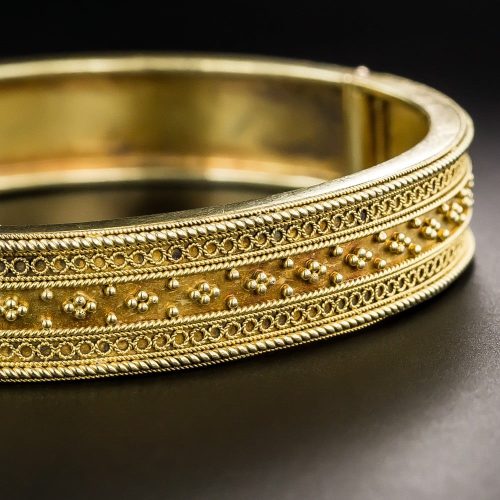
Granulation (from Latin: granum = "grain") is a goldsmith's technique whereby the surface of a jewel is decorated with small spheres of precious metal (named granules), according to a design pattern. The technique is said to originate from Sumeria (present day Iraq) from as early as the 3rd millennium BC[1] and was later (first millennium BC) adopted by the Etruscans in present day Italy. The ancient Greeks employed granulation work as well, yet it was the craftsmen of Etruria who became famous for this technique due to the mysterious deployment of fine powder granulation [2] without apparent use of hard solder. A technique which was only rediscovered (it was never actually "lost") in the early 20th century after many fruitless attempts in the second half of the 19th century; mainly by Alessandro Castellani.

During the first half of the 1800's several excavations were carried out in the vicinity of Rome (Cerveteri, Toscanella and Vulci) and Southern Russia (the Kertch and Taman peninsulas) which revealed resp. ancient Etruscan and Greece jewelry. These jewels were decorated with granulation and was brought to the attention of the Castellanis who were involved in antique jewelry research at the time. It was especially the finds from the Etruscan burial sites that attracted attention due to their use of very fine granules. Alessandro Castellani studied these artifacts in great detail to unravel the method of fabrication. It was, however, not until after his death that the puzzle of colloidal/eutectic soldering was finally solved, in the early part of the 20th century. The Etruscans also used a fusing technique to adhere the small beads onto golden plates.

Although the secret remained undisclosed to the Castellanis and their contemporaries - as Mellilo -, they started an archaeological revival of Etruscan jewelry around the 1850's and they deployed goldsmithing techniques to reproduce some of the finest ancient jewelry ever excavated. Many of their objects are now in important jewelry collections around the globe, together with the original counterparts.

Contents

Technique

There are three main techniques to adhere small granules to the surface of a jewelry item - hard soldering, fusing and colloidal soldering. The materials used for granulation are usually high gold and/or silver alloys. In general alloys below 18 kt. gold and sterling silver are not suited. In every case the process starts with the creation of the granules themselves.

Granules

The granules are made, preferably, from the same alloy as the jewel itself. A sheet of metal is rolled out thin and narrow fringes are scissored on it, then the fringes are cut to form small squares (like paillons) of metal. The goal is to create evenly sized spheres with a diameter of no larger than 1 mm, though larger ones can be used in certain cases. The metal platelets are now coated in charcoal powder to prevent them from sticking together during firing. The bottom of a crucible is covered with a layer of charcoal and a portion of the platelets are sprinkled on it in a fashion that they are as evenly spaced as possible. This is followed with a new layer of charcoal powder and metal platelets until the crucible is about 3/4 full (or less). When the crucible is fired in a kiln or oven, the precious metal platelets will warp into small spheres at the appropriate temperature. These are left to cool and cleaned in water, or through pickling in acid when soldering is required.

It is impossible for the goldsmith to create spheres of the exact diameter and the granules must be sorted prior to use; grains of uneven size would not generate a nice design. For this purpose the granules are sorted according to size with a series of sieves. These can be made in the workshop [3] or bought as a diamond sieve with the smallest holes possible. Another technique is to create the grains from very thin wire that is coiled around a thin mandrel (like a needle) and then cutting them into jump rings.

Hard soldering

Soldering two metal items together relies on the capillary action of a solder - of lower melting point - between the two metals. This is a very common procedure for bench jewelers and is practiced, unaltered, since ancient times. Soldering small grains of metals, however, poses a problem as one should create very small paillons and position them near to the point of contact between the granule and the metal. One would succeed once or twice, but this is impossible to do with when one needs to decorate a whole surface with the metal spheres. Additionally any flux that needs to be applied will easily dislocate the minute paillon.

To overcome this, one can file the solder to a coarse powder and mix it in with the flux (borax) in a small can, named a "rochoir"[4]. This can has a spout with a ribbed back (looking much like a child's drawing of the neck of a stegosaur) and when one rattles the index finger over it, only a small dose of the solder filings/flux mixture is released. Allowing the goldsmith to sprinkle it in sufficient amounts on the work. Most goldsmiths that need this device make it themselves as they are not offered by jewelry tool manufacturers.

The area to which the granules are to be attached is painted with tragacanth - which acts as a glue - and the granules are positioned on it with a very fine paintbrush. After drying the granules are sprinkled with the borax-solder filings and heated to the point that the solder will flow under the granules through capillary action. This process will leave solder remnants in the gaps between the granules which can not be removed.

This method was not used by the ancient Greece or Etruscans, Castellani however did create items using this technique.

Fusing

In fusing two metals of the same alloy are welded together through the mere use of heat. A sheet of metal with approx. the same thickness as the diameter of the granules is used to get an even heat distribution. Once the granules are positioned in place, with a diluted flux and a fine paint brush, the whole is fired in an oven with reducing atmosphere and, at the point just on the melting temperature, the two mediums start to fuse together. The great advantage of this method is that no flux or solder remnants are left on the artifact, it is however an advanced goldsmithing technique that requires great skill and practice.

This method was unknown to the Castellani and his Italian contemporaries, yet the Etruscans practiced this technique in the first millennium BC.

A more modern way is fusion-welding with a tack welder. This applies an electric current through the materials which is enough to fuse the granules on the object. The advantage of this method is that one can work with finished jewelry items, even those already stone set. The disadvantage lies in the fact that the granules may not touch each other or the current flow will be drawn to the neighboring granules, resulting in looser joints.

Colloidal soldering

Colloidal soldering is one of the techniques that was used in Etruria and the technique was only "rediscovered" in the early 20th century, after many failed attempts by the Castellani to unravel this "lost" secret. It makes use of a - colloidal - mixture of tragacanth gum and copper salts. This compound will lower the melting temperature of the two metals in contact (the granules and the base) after which the copper diffuses into both at the point of contact to form a strong metallic bond. Due to the lowering of the melting point this is also termed eutectic soldering.

The copper salts can be of a few recipes:

  • Cuprous oxide - CuO
  • Copper hydroxide - Cu(OH)2
  • Copper chloride - CuCl2 * H2O
  • Copper sulphate - CuSO4 *5H2O
  • Copper carbonate - CuCO3 * Cu(OH)2 - This can be obtained by crushing malachite.

The surface of the artifact is painted with the colloidal solder and the granules are arranged on it with a fine paint brush and left to dry slowly. The whole is fired in a reducing atmosphere and the tragacanth will burn away while the copper salt is released from the compound. At the eutectic soldering temperature (ca. 890 degrees Celsius) the copper diffuses in both the granule as the base alloy. This requires good timing and great skill from the performer.

Due to the copper salts this is also named chemical soldering.

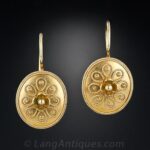
An example of fine granulation. Indian Earrings, 1st century BC

Notes

  1. Maxwell-Hyslop
  2. Ogden, 189
  3. Making a Granulation Sieve
  4. Ogden, 185

Sources consulted

  • Maxwell-Hyslop, Rachel K.. The art of granulation in early Iranian Gold Jewellery, 5th International Congress of Iranian Art & Archaeology 1972.
  • Brepohl, Erhard. The Theory and Practice of Goldsmithing
  • Vakboek Edelsmeden. Vakschool Schoonhoven, The Netherlands. 1985.
  • Fachkunde Edelmetallgewerbe. Rühle-Diebener-verlag.
  • Untracht, Oppi. Jewelry Concepts and Technology. Robert Hale & Company. ISBN 978-0709196167
  • Ogden, Jack. 'Revivers of the Lost Art: Alessandro Castellani and the Quest for Classical precision. In Castellani and Italian Archaeological Jewelery, ed. Stefanie Walker Susan Weber Soros, 180-198. New Haven: Yale University Press, 2004. ISBN 0300104618
  • Simpson, Elizabeth. 'A Perfect Imitation of the Ancient Work: Ancient Jewellery and Castellani Adaptations' In Castellani and Italian Archaeological Jewelery, ed. Stefanie Walker Susan Weber Soros, 200-226. New Haven: Yale University Press, 2004. ISBN 0300104618

Museums

  • National Etruscan Museum, Villa Giulia, Rome, Italy.
  • Museo Gregoriano Etrusco, Vatican.
  • Victoria and Albert Museum, London, United Kingdom.
  • The British Museum, London, United Kingdom.