
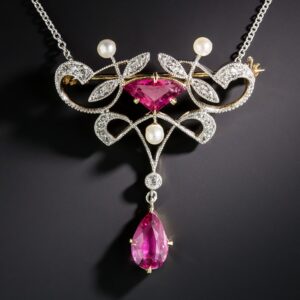
Tourmaline is a group of minerals displaying the widest variety of gemstone color in the mineral kingdom. The spectral assortment of color in tourmaline is a result of substitutions of transition elements for other metallic elements in the crystal structure. Usually pink is due to manganese, and green is attributed to ferrous iron, chromium or vanadium. The color can sometimes be improved by heating and/or irradiation, but these improvements are not always permanent. Tourmaline is a complex borosilicate, crystallizing in the trigonal system. It is hard and durable and therefore very well-suited for jewelry.
Tourmaline is a pyroelectric mineral, meaning that when warmed, it attracts dust and other lightweight particles. This property has important electronic and industrial applications.
The tourmaline find of the century was made in 1989 in the village of Sao Jose da Batalha in the state of Paraiba in northeastern Brazil. Small crystals of elbaite tourmaline were found, colored by bivalent copper, their colors were electric neon shades of blue, pink, green and violet. The demand and prices for these gems soared astronomically, but they were in very short supply. The mine closed in 1993, after four short years. Recently there have been discoveries of a similar variety of cupric elbaite in Mozambique.
A Brief History of Tourmaline
The first discoveries of tourmaline were made on the Isle of Elba. The term elbaite is used to describe most varieties of tourmaline used in jewelry today. The name tourmaline is derived from the Sinhalese word “turmali” which means mixed and unidentified stones. In 1703 a parcel of “turmali” arrived at a Dutch lapidary. Legend has it that children were playing with the stones in the sunlight and noticed that they were attracting bits of ash and straw-like a magnet attracts metal. This inspired further investigation and a multitude of gem varieties were tested. It was noted that while very few individual gems possessed this pyroelectric ability, pyroelectric gems occurred in every imaginable color. It took almost 100 years to determine all the pyroelectric gems were the same mineral: varieties of tourmaline.
Tourmaline is a large family of minerals composed of a complex boro-silicate. The most common species of the tourmaline group is Elbaite (named after the island of Elba in the Mediterranean) and it occurs in all colors of the rainbow. It was first brought to Europe by Dutch traders who also discovered its pyro-electric effect. When heated, tourmaline is electrically charged, this charge was used to attract ashes from a smoked pipe and these stones thus received the glorious name of asschentrekker (old Dutch for ash puller).
Another property that tourmaline is famous for is its ability to totally block color when viewed in a particular direction and it is due to this strong selective absorption property that some darker stones were used as early polarizing filters.
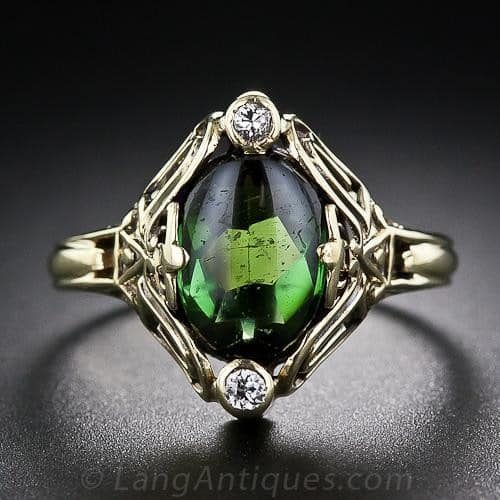
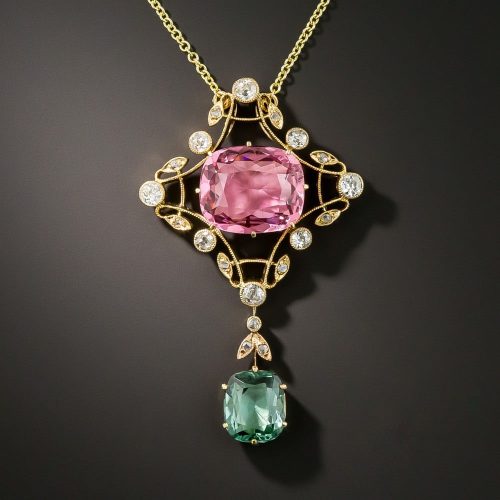
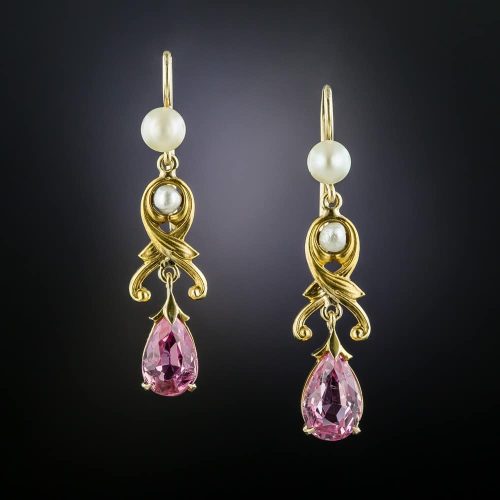
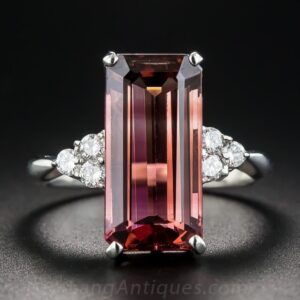
Tourmaline Varieties
There are many color varieties in the tourmaline group and some have distinctive tradenames:
- Rubellite – pink to red
- Verdelite – green
- Indicolite – blue
- Achroite – colorless
- Dravite – brown
- Schorl – black
- Watermelon – pink core with a green periphery
- Parti-Colored – several colors in one stone
More recently a variety was discovered in the Paraiba state of Brazil which exhibits neon colors. These are also found in the neighboring state Rio Grande do Norte, as well as in Africa.