Loading...

Egyptian Blue

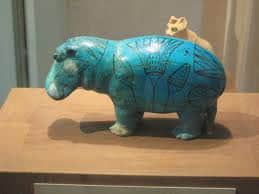
Egyptian Blue Faience
Egyptian Blue Faience.

Egyptian blue was a synthetic pigment used in Egypt, starting around the 3rd millennium BC, to imitate turquoise and lapis lazuli. Blue was an important color to the Egyptians and natural gemstones possessing a vivid blue color were very rare in the region. Necessity being the mother of invention, the Egyptians were driven to create the earliest known synthetic pigment. Staggering amounts of Egyptian blue were needed to make all the beadsseals, icons, decorative displays, and objects that were composed with the use of the color blue.

As best as we can reconstruct, Egyptian blue was composed of quartz sand, copper, calcium carbonate, cuprorivaite, and plant ash or natron. These were melted together, resulting in the creation of Egyptian blue. Ancient Egyptian blue has been identified by archaeologists through the use of red light to excite the cuprorivaite in the pigment. The recipe eventually fell out of use, and the process has been sought by many throughout the millennia. Recently, a team of scientists from Washington State University, the Carnegie Museum of Natural History, and the Smithsonian’s Museum Conservation Institute joined forces to tackle the problem.

A dozen recipes using crystalline silicon dioxide, copper, calcium, and sodium carbonate were tested. Temperatures of greater than 1800 degrees Fahrenheit for periods of up to eleven hours were tried. Each of the twelve resultant pigments contains cuprorivaite, the crucial ingredient necessary to create the Egyptian blue’s signature luminance under red light. The combination of components with the cuprorivaite is key to the final coloration of the pigment.

It is interesting to note that ancient Romans also used Egyptian blue mixed with white to paint human eyes, making them appear more realistic. During the Renaissance, at least one painter, Raphael, is also known to have used this technique.

Source

  • Anderson, Sonja. “Archaeologists Are Recreating the Long-Lost Recipe for Egyptian Blue, the World’s Oldest Known Synthetic Pigment.” Smithsonian Magazine. June 12, 2025, https://www.smithsonianmag.com/smart-news/researchers-are-recreating-the-long-lost-recipe-for-egyptian-blue-the-worlds-oldest-known-synthetic-pigment-180986778/, Accessed 10/17/25.
Close Menu
×