
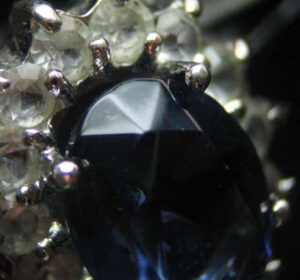
Photo by JB.
Paste is a synonym for glass when used in the context of a gem material. Glass has been used as a gemstone imitation since ancient history for obvious reasons: it’s transparent, can be colored in many ways and resembles all kinds of gemstones when polished.
The first paste ‘forgeries’ are thought to have been introduced into Ancient Greek society although glassmaking had been around for a long time by then.
Paste imitations have been found in archaeological diggings and collections from over the past 2000 years. First as cabochons and beads later as faceted stones as well. In 1674 an English glassmaker, George Ravenscroft (1618-1681), patented a new glass that was made with a higher lead oxide content and had a higher Refractive Index (RI) than before. It was a brilliant glass with high dispersion. All kinds of varieties of composite stones involving paste have been brought on the market. One scheme is more cunning than the other. Paste gemstones can be recognized fairly easily by gemologists who look for gas bubbles, swirly texture and singly refractive stones with a certain range of RI.
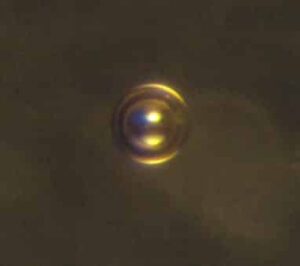
Photo by Tim Spauwen.
Glass is an amorphous material; it lacks a repeating, three-dimensional, array of atomic bonding and therefore. In other words: it has a random arrangement of their bonding, it lacks crystal structure. Glass is a result of rapid cooling of molten silicon oxide (SiO2) and a few additives. This rapid cooling prevents the atoms to ‘settle into a regular pattern causing the amorphous structure.
The above has a few consequences: due to the amorphous structure glass is single refractive instead of double refractive like most gemstones it imitates. It isn’t as hard as most crystalline substances it imitates and its not as cold to the touch. This was mentioned by Pliny the Elder in his Naturalis Historia written in the first century AD:
To test the validity of the gem there is several ways the first by it’s weight because the real ones are heavier and then by the temperature, because the real ones feel colder in the mouth.1
Notes
- Pliny the Elder, Naturalis Historia, Translation by van Gelder, Nieuwenhuis and Peters, Published by Polak & van Gennep, Amsterdam 2005.↵