
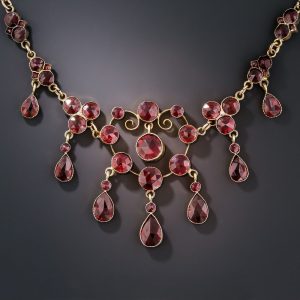
The term garnet applies to a group of minerals with six main varieties. The varieties differ in chemical composition and color but share the same crystal system. These varieties are:
- Almandine
- Pyrope
- Grossular
- Spessartite
- Uvarovite
- Andradite
While most people think of garnets as red, they occur in almost every color. The rarest is blue. Garnets can be found throughout the world. The United States, Brazil, Canada, Germany, Russia, Madagascar, Tanzania, Kenya, and India have produced abundant amounts.
A Brief History of Garnet
Garnets have been widely known for thousands of years and are found in jewelry from ancient Egyptian, Greek, and Roman eras. The Greeks called garnets “nuktalopos” meaning “lamp stone”. They believed that wearing a garnet around the neck gave one the ability to see in the dark.
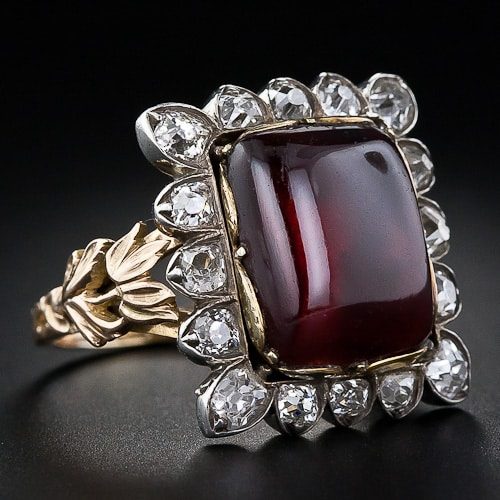
Noah, it is reported in one biblical legend, used a lantern made from garnets in order to safely steer his Ark through the darkness of the night. Cabochon cut garnets have been very important in Christianity, often used to represent Christ’s passion and martyrdom.
During the Middle ages, garnets were used to protect against the plague, eliminate sadness, and prevent evil thoughts. And when hung around the neck, garnets were a sure cure for indigestion and sore throats.
Garnet is the birthstone for January and the gem to commemorate the 2nd Anniversary.
Meet the Family
Astutely observed by Mab Wilson, author of Gems:
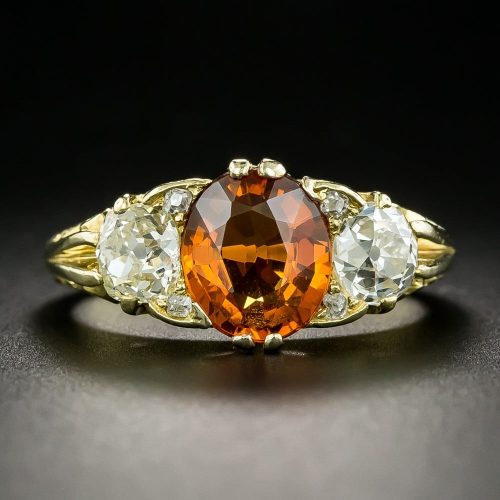
Most of us, having been brainwashed by the dark and depressing parures of the turn of the century, forget the many beautiful colors garnets can have. Badly cut, a garnet can indeed be a melancholy object, lugubriously red and usually in a brown study; but a clear and well-cut garnet can be bright as a zinnia, as dark as a bottle of red ink, as green as an emerald or the very green of a dew-moistened leaf of the lily of the valley.1
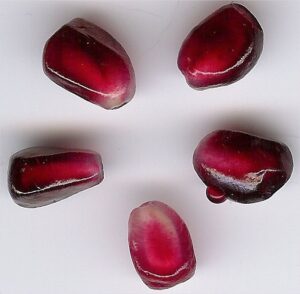
This Fruit may Have Given Garnet its Name.
Garnets, with their wide range of colors and varieties, have long been an important gem material throughout history with research dating their use back to the earliest known civilisations.
The name garnet is derived from the Latin word granatas, meaning grain or seed. Historically the red varieties of this gemstone, which resemble the seeds of a pomegranate in color, were referred to as garnets. The term garnet has come to refer to the whole family of minerals that crystallize in the cubic system and share the same chemical blueprint. The elements used to fill that blueprint place a gem garnet into one or more of the following:
- Pyrope: Mg3Al2(SiO4)3 (magnesium aluminum silicate)
- Almandine: Fe3Al2(SiO4)3 (iron aluminum silicate)
- Spessartine: Mn3Al2 (SiO4)3 (manganese aluminum silicate)
- Grossular: Ca3Al2(SiO4)3 (calcium aluminum silicate)
- Hydrogrossular: Ca3Al2(SiO4)3-x(OH)4x (calcium aluminum silicate with hydroxide)
- Andradite: Ca3Fe2(SiO4)3 (calcium iron silicate)
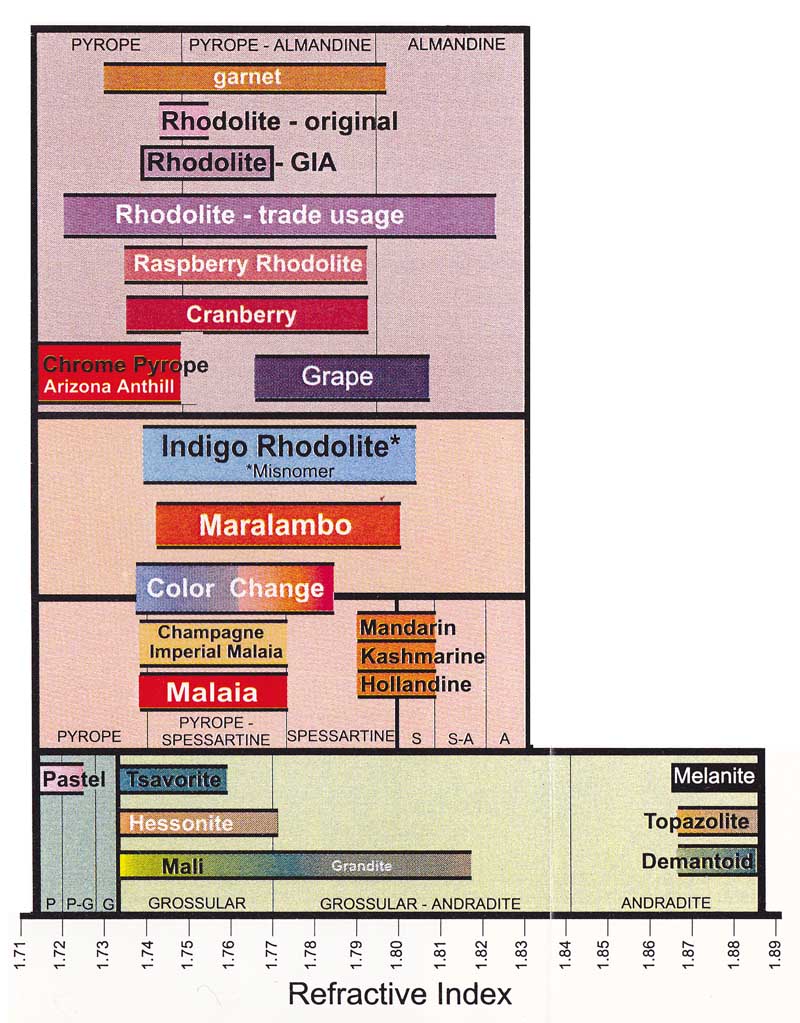
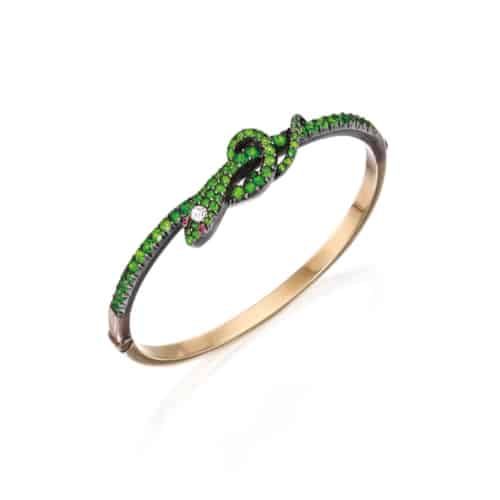
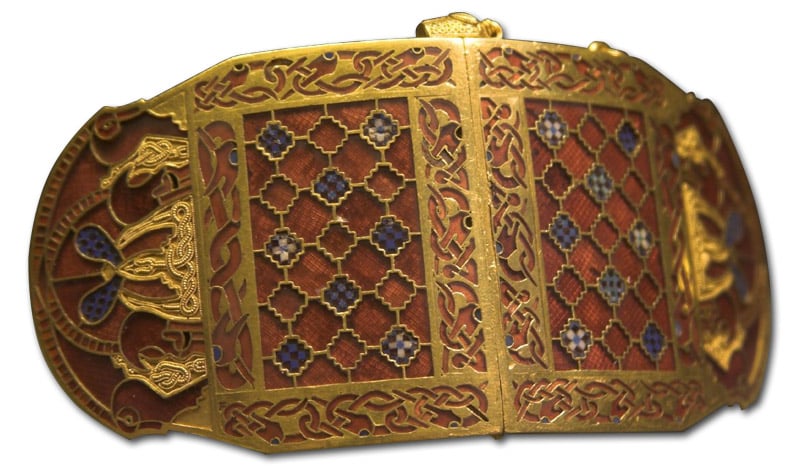
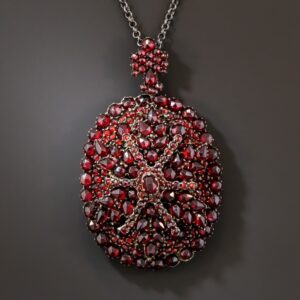
During the Victorian era garnets were extremely fashionable; rose-cut garnets from the Czech Republic often covered entire jewelry items. These garnets are better known as Bohemian Garnets after the area they were mined: Bohemia.
Bennet & Mascetti report:
Perhaps there are no jewels more emblematic of the mid-century [1850s] in Europe than those set with carbuncles – deep-red almandine garnets cut en cabochon. These modest gems with their deep, rich colour , perfectly reflected the ripeness and succulence of Romantic Naturalism. Carbuncles featured prominently in jewels in England and Germany, where the royal families favoured them. The richness of their colour conjures up the rich red velvets and floral brocades that were fashionable at the time.2
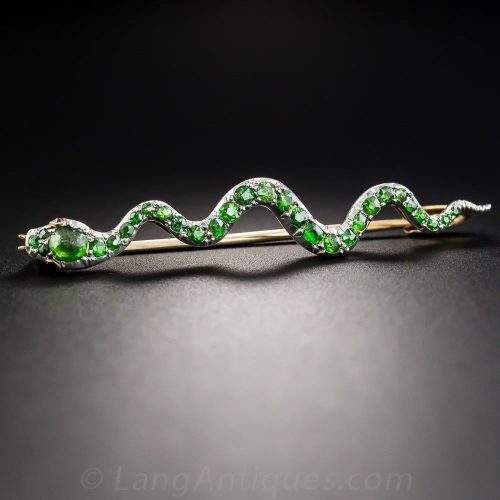
Andradite was discovered in the Ural Mountains of Russia circa 1853. This distinctively bright green garnet was given the name demantoid in 1878. It quickly became a “hot” gemstone punctuating ‘turn of the century’ jewelry.
In the last quarter of the 20th century, various additional garnet varieties have been found in Africa.

Victorian Bohemian Garnet Bangle Bracelet
Round and round they go—five rows of closely set rose-cut garnets create a darkly romantic, glistening dusky wine-red glow all around your wrist, courtesy…
SHOP AT LANG
Victorian Color-Change Garnet Riviere Necklace and Bracelet Set
A rare and remarkable beauty, this luscious Victorian necklace presents 29 graduated emerald-cut garnets, many of which have the unusual characteristic of color…
SHOP AT LANG
Retro Cabochon Garnet and Diamond Ring
An uber-cool and striking Retro ring, circa 1940s, artfully sculpted in 14 karat yellow gold around a deeply saturated dusky wine red 8.50 carat cabochon garnet…
SHOP AT LANG