
Rose-Cut Diamonds: Their Beauty and Allure
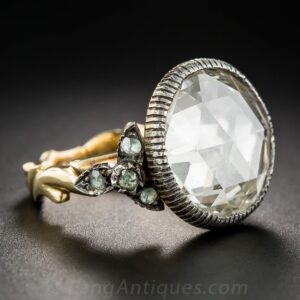
Early “diamond cuts” were essentially diamonds altered with only minor changes and a light polishing before being set into jewelry. The point-cut and table-cut are classic examples of this minimal fashioning and, while they had a devoted following, another glitzier, more interesting and more fully fashioned diamond, the rose-cut, soon gained popularity. Diamond cuts are, in many ways, influenced by the shape of the rough and rose-cuts are no exception. Early rose-cuts were fashioned from diamond rough that easily lent itself to this flat-bottomed dome-topped design. Varying numbers of triangular facets are responsible for the rose-cut’s amped-up level of scintillation and sparkle.
It might even be said that early diamonds have an allure and mystery that are sometimes more entrancing for their imperfect shapes.1
The discovery by Brazilian gold miners of abundant diamonds in river gravel c.1725, came just as the traditional sources in India were running dry and caused a flood of diamonds to reach the market with the resultant plummeting of prices. This vast supply of “affordable” diamonds made them all the more desirable for the insatiable appetites of Europe.
Nothing glimmered better by candlelight than rose-cut diamonds. A surprising driving force in the increased popularity of diamond evening jewelry derived from technological advances in candle making. Candles were scarce and expensive (not to mention heavily taxed) but during the Georgian Era new discoveries in wick and candle making along with cleaner, longer burning candle “recipes” finally made them available to the masses and en mass to the wealthy. The impact on the diamond-wearing public was nothing short of electrifying.
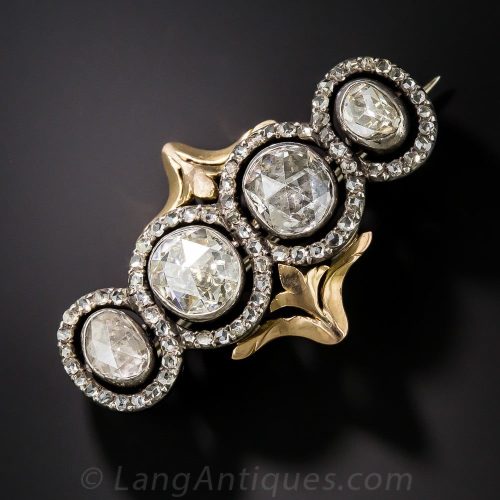
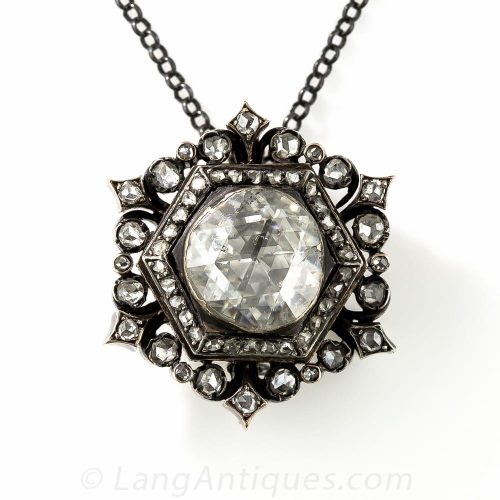
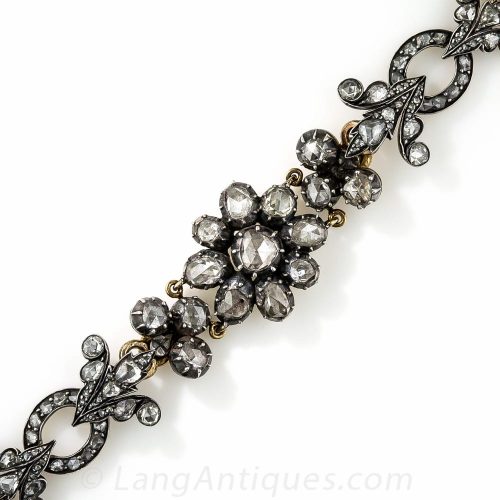
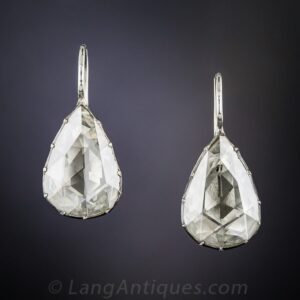
As crafty diamond cutters developed new techniques, more complicated facet arrangements and more pleasing outlines were possible. The cutting centers of Amsterdam and Antwerp produced the best rose-cuts including the Dutch rose which had a more complex arrangement of facets in groups of six. The outline of the stone was still primarily influenced by the outline of the rough, but the ability to create more precise outlines came with maturing cutting technology. Although the brilliant-cut diamond was already in the early stages of its development, they were heavy and very expensive. In the book “Diamonds A Study of the Factors that Govern their Value” the author states:
In fact, when the brilliant form was first introduced (the old, square, thick “old-mine cut”), many people of taste are said to have preferred the well-made, rose-cut stones2
The rose-cut’s superior brilliance, scintillation and larger (but lighter) surface area maintained a steady following throughout most of the Georgian Era. As the eighteenth century morphed into the nineteenth, a combination of the availability of more diverse diamond rough and the ability to set diamonds in open back, lighter and airier mountings, temporarily put the rose-cut on the back shelf or to the cutters for refashioning. By the mid-nineteenth century, there was a resurgence of popularity for the more exquisite rose-cut diamonds perfected in Belgium and the Netherlands. In addition, an American rose-cut was patented circa 1900 which fueled enthusiasm for the cut on yet another continent.
In 1865 Harry Emanuel (author of Diamonds and Precious Stones) asserted that the better kind of rose diamonds had recently enjoyed a renewed popularity, ‘as the same amount of display’ might be obtained ‘at less than half the cost of the brilliant’.3
While the rose-cut moved in and out of the spotlight it never quite faded away. What’s old is new again and a recent article in Modern Jeweler reports that a revival of the rose-cut has caused a crisis of supply and demand and cutters in India are racing to meet the need for rose-cuts to be used by twenty-first-century designers.
The new love for rose cuts comes almost too late. The remaining population of vintage rose cuts has so dwindled that it is silly to hope that this style of cutting will ever come off the endangered species list. Vintage rose cuts are such rarities, especially clean ones in good shape, that designers hoard the few they can find until they have enough stones for pieces featuring them.4
History and Development
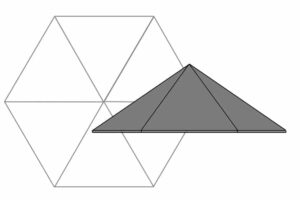
The Earliest and simplest Rose Cuts are no more than three or six facets ground onto a crystal tip with a flat bottom. They often were very flat stones and occasionally they are found with a rounded outline. These stones appeared in the 16th century and their complexity increased in the centuries after their first arrival. The number of facets increased as well as their placing on the crown. Please note that all these illustrations represent schematic shapes. In reality, Rose Cuts were hardly ever symmetrical and are usually found with rather irregular outlines.
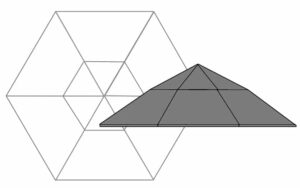
From the 6-facet Rose it was a small step to the 12 facet Rose which is ‘crowned’; it has a second row of facets. This intermediate stage in between the full Rose Cut and the simplest of all Rose Cuts, the three-facet Rose, was found to provide some brilliance but no dispersion.
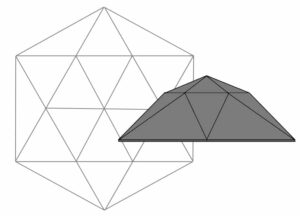
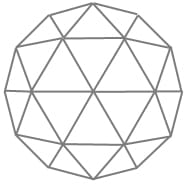
Realizing that this was due to the smaller facets the next logical step was to cut more facets onto the crown. These stones became rather popular during the 19th century. They were cut mainly in Amsterdam which, by this time, had taken over the function of Diamond Centre of the world from Antwerp.
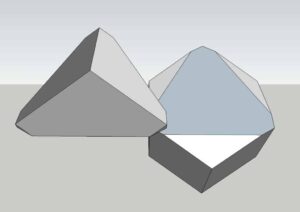
The final stage in the evolution of the Rose cut is the Full Rose cut or twenty-four-facet Rose Cut. The oldest known Full Rose Cut is set in a pendant that is believed to date back as far as the end of the 16th century.
Cleaved-off sections of dodecahedral crystals form ideal starting material for rose cuts. On the left you see the product of cleaving a full dodecahedron. The bulky part can be fashioned into a pavilion-based stone while the tip is a natural 3-facet Rose.
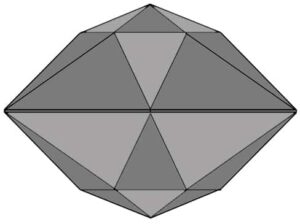
The term ‘Double Rose’ refers to one stone that has the Rose Cut design for both its crown and its pavilion.
Sources
- Dawes, Ginny Redington Dawes with Collings, Olivia. Georgian Jewellery: 1714-1830: Woodbridge, Suffolk, UK: Antique Collectors’ Club, 2007.
- Emanuel, Harry. Diamonds and Precious Stones: Their History, Value, and Distinguishing Characteristics. New York: G.P. Putnam’s Sons, 1873.
- Federman, David. “Rose-Cut Diamond.” Modern Jeweler Copyright © 2016. http://www.modernjeweler.com/Cygnus Interactive, a Division of Cygnus Business Media. Accessed August 1, 2016.
- Tillander, Herbert. Diamond Cuts in Historic Jewellery 1381-1910. London, England. Art Books International, 1995. ISBN 1874044074
- Wade, Frank B. Diamonds: A Study of the Factors That Govern their Value. New York: G.P. Putnam’s Sons, 1916.
- Old European Diamond Cuts at Khulsey.com