Chrysoberyl
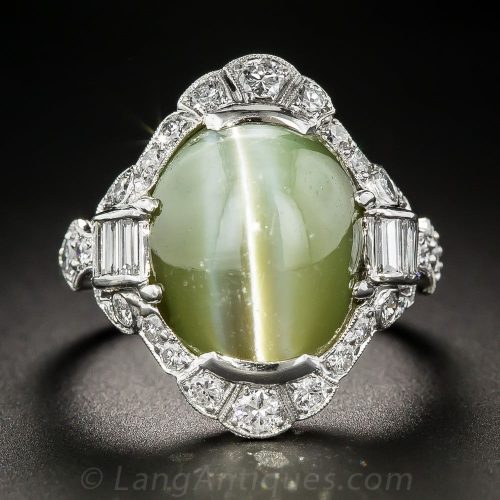
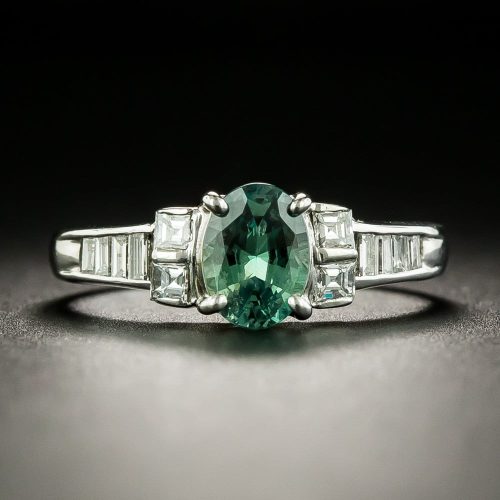
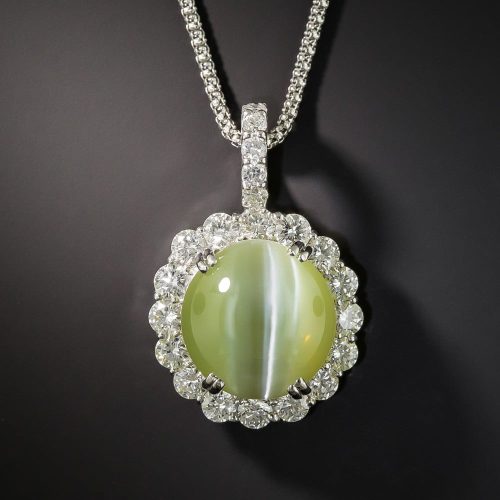
Of all commonly used - natural - gemstones, chrysoberyl is only surpassed by corundum and diamond in its hardness and brilliance. The name is derived from the Greek "golden beryl", but it differs much from beryl both in chemical composition as in crystal structure. Chrysoberyl -as a gem - is yellow to green in color with a transparent varieties, namely the color changing alexandrite and cymophane (chatoyant chrysoberyl).
Image courtesy of Lang Antiques
Sri Lanka and Brazil hold the main deposist of fine quality, transparent greenish yellow, chrysoberyl and they were very popular in the Victorian an Edwardian Europe.
When traders speak about "cat's-eye" without a postfix, cymophane is implied and this gemstone has the longest history of the chrysoberyls. It was treasured in Biblical times in Asia and in a Vishu necklace a cymophane was the representation of the magnetic center of human passion. During Victorian times the popularity of cymophane reach its peak after Prince Arthur, Duke of Connaught and Strathearn and 3rd son of Queen Victoria, gave his future wife - Princess Louise Margaret of Prussia - a betrothal ring set with a chrysobery cat's-eye in 1860[1].
Metaphysically speaking, chrysoberyl has been attributed the power to foster meditation and to balance one's energy. It has for long been credited to improve eyesight and to protect against evil. It may also induce better relations with neighbours. The Arabs believed it could make one invisible on the battlefield.
As a wedding gift cymophane symbolizes the 18th anniversary.
| Gemological information for Chrysoberyl | |
|---|---|
| Color | Yellowish-green, yellow, brown. Alexandrite: blue-green to green red to purple color change |
| Crystal Structure | Orthorhombic |
| Refractive Index | 1.74 to 1.75, birefringence 0.008 to 0.010 |
| Family | Chrysoberyl |
| Durability | Excellent |
| Hardness | 8.5 |
| Similar stones | (sythtetic) Corundum, Citrine, Tourmaline, Garnet, Peridot |
| Treatments | None |
| Optical phenomena | Cat's-Eye |
| Country of origin | Sri Lanka, Brazil, Myanmar, Zimbabwe, Madagaskar, India |
| Chrysoberyl care | |
| Ultrasonic cleaning | safe |
| Steam cleaning | safe |
| Warm soapy water | safe |
| Chemical attact | avoid |
| Light sensitivity | none |
| Heat sensitivity | safe |
Notes
- ↑ reference needed
Online G&G articles on chrysoberyl
- Jan. 1934, Chrysoberyl, p. 9, 2pp.
- Winter 1937, A grayish-green star chrysoberyl, p. 130, 1p.
- Fall 1945, A 115 ct. star chrysoberyl (non-gem quality), by Anderson, p. 252, 2pp.
- Spring 1949, The Origin of Alexandrite Color Change, p. 143, 3pp.
- Spring 1949, Chrysoberyl, p. 147, 1p.
- Fall 1953, Inclusions in Yellow Chrysoberyl, by Webster, p. 343, 4pp.
- Spring 1954, Separating yellow chrysoberyl and yellow corundum, p. 32, 1p.
- Spring 1959, A 45 ct., a 12 ct., and a 50 ct. alexandrite, p. 264, 1p.
- Summer 1960, A 4-rayed star brown chrysoberyl, p. 62, 1p.
- Winter 1963, A cat's-eye alexandrite, p. 104, 2pp.
- Fall 1964, Synthetic alexandrite made, p. 216, 1p.
- Fall 1967, Cat's-Eye Doublet, p. 215, 2pp.
- Summer 1970, High-Property Cat's-Eye (R.I. 1.76–1.77), and absorption spectrum, p. 184, 2pp.
- Winter 1972, Synthetic alexandrite, introduced to the market by Creative Crystals, Inc., Danville, Calif., p. 102, 3pp.
- Winter 1972, Chrysoberyl cat's-eye, proved to be natural, p. 113, 1p.
- Winter 1972, Fine cat's-eye glass with milk and honey effect, p. 108, 1p.
- Spring 1973, Fine cat's-eye glass and optic fibers with milk and honey effect, p. 136, 3pp.
- Winter 1974, A new synthetic alexandrite by the Czochralski Method, p. 367, 3pp.
- Summer 1976, A very rare 4-ray star cat's-eye chrysoberyl, p. 170, 1p.
- Fall 1976, Alexandrite from Lake Manyara, Tanzania, by Gübelin, p. 203, 11 pp., with bibliography
- Fall 1976, African alexandrites?, p. 211, 3pp.
- Spring 1979, Natural & Synthetic Alexandrites, p. 148, 1p.
- Spring 1980, Fiber optic cat’s-eye imitation, p. 278, 1p.
- Summer 1980, A Giant Chrysoberyl Crystal, p. 320, 2pp.