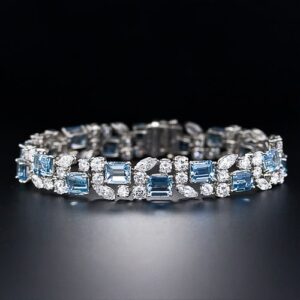
Oscar Heyman & Bros. is an American jewelry firm and manufacturer that first gained attention in the 1920s. In 1906, Oscar and Nathan Heyman immigrated to the United States from Latvia.1 Thanks to an apprenticeship at their great-uncle’s Fabergé workshop, they arrived with a skill that made them instantly employable: they could work with platinum, a metal relatively new at the time. Oscar was hired to work in Cartier’s first New York workshop at 712 Fifth Avenue, the first non-French bench jeweler hired by the firm.2 When the whole family moved to New York in 1912, the brothers opened a workshop of their own: Oscar Heyman & Bros.
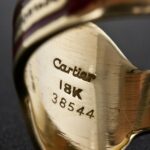
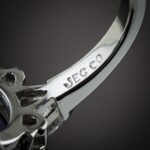
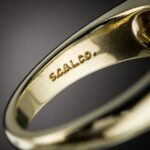
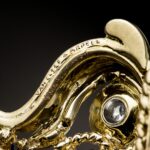
Since then, the firm has been a self-proclaimed “jeweler’s jeweler,” producing pieces for, among others, Cartier, Van Cleef & Arpels, J.E. Caldwell, and Shreve, Crump & Low. They had a staff of salesmen who traveled throughout the country returning with orders for the workshop to fill. They did not maintain a storefront or sell directly to the public until quite recently.
The firm’s reputation for craftsmanship is unsurpassed. Their technical skills learned in the Russian workshop uniquely placed them to successfully attract the most prestigious firms as their clients. Nathan’s skills as a die maker lead to seven unique patents beginning in 1916 with a cleverly hinged round diamond link. In 1922 a die-stamping machine for producing line bracelets with articulated links lead to another patent for the firm. Therefore, in 1939, when it became imperative for Van Cleef & Arpels to produce their serti mysterieux jewels in the United States, using their invisible setting technique, who better than Oscar Heyman & Bros. to execute the job.
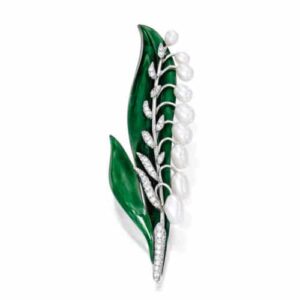
Photo Courtesy of Sotheby’s.
The 1939 World’s Fair came at a time when Americans were celebrating the end of the Great Depression and a “House of Jewels,” devoted to the jewelry trade, was included among the many exhibits. Competition for space was fierce as the American jewelers had been excluded from the 1925 and 1937 French expositions, everyone was anxious to show the world their wares. Most of the prestigious American firms were represented. Oscar Heyman & Bros., although without their own display space, were well represented at the fair in the booths of four major New York jewelry houses for whom they crafted jewels. Their high level of workmanship, exquisite designs, and high-quality gemstones stood out to those in the know. Not to be ignored, the firm reinforced its elusive presence (at least to the general public) with a series of Fair-themed ads pointed at the jewelry trade noting their involvement. Known for its floral-motif pieces, the firm won gold medals for a collection of orchid, pansy, and gardenia brooches.3
The advent of war made jewelry production all but obsolete. Gems were hard to come by and platinum was reserved for wartime use to name just a few wartime restrictions. Many firms retooled to be able to contribute to the war effort and Oscar Heyman & Bros. was no exception. Jeweled bearings, normally produced in Switzerland, were now produced by the brothers in the United States. These critical components used in airplane instruments, compasses and watches took over the majority of their workshop the remainder produced some of the most beloved patriotic jewelry of the era.
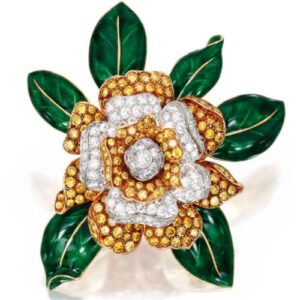
Photo Courtesy of Sotheby’s.
Floral brooches were a mainstay of the firm and in the 1950s they added the “ballerina ring” to their repertoire, both have remained top sellers. The 1960s brought other changes to the firm, the youngest Heyman, George, was appointed to succeed Oscar and the next generation took over the running of the firm. in 1964 They partnered with the Linde Star Corporation to produce a commemorative necklace for the New York World’s Fair. Hollywood came calling and through an association with Laykin et Cie they provided jewelry suites worn by Lana Turner in the Imitation of Life. Another big star, Elizabeth Taylor, had fine examples of Oscar Heyman & Bros. creations in her collection. Famously, in 1969, Cartier entrusted them with a commission to design and produce the setting for the Taylor-Burton Diamond, a task that the firm successfully completed with great fanfare.
A commission from the Society of the Cincinnati in 1971 to create a replica of the badge of their historic Diamond Eagle crafted in Paris in 1787 was judged to be equal to the original. Tiffany & Co. joined the long list of renowned clients alongside J.E. Caldwell and VCA who still relied on the firm for some of their most iconic creations. They created band rings, flag brooches, pansy brooches and other floral creations for Tiffany for many years.
Able to go with the flow of change in jewelry aesthetics, Oscar Heyman & Bros. has continued to produce lovely pieces, specializing in platinum jewelry with diamonds, sapphires, emeralds, and rubies down through the decades. More recently morphing from filling orders for other jewelers the pendulum has shifted to an emphasis on production of their iconic jewelry in their own name. The third generation of Heyman family members now runs the business.
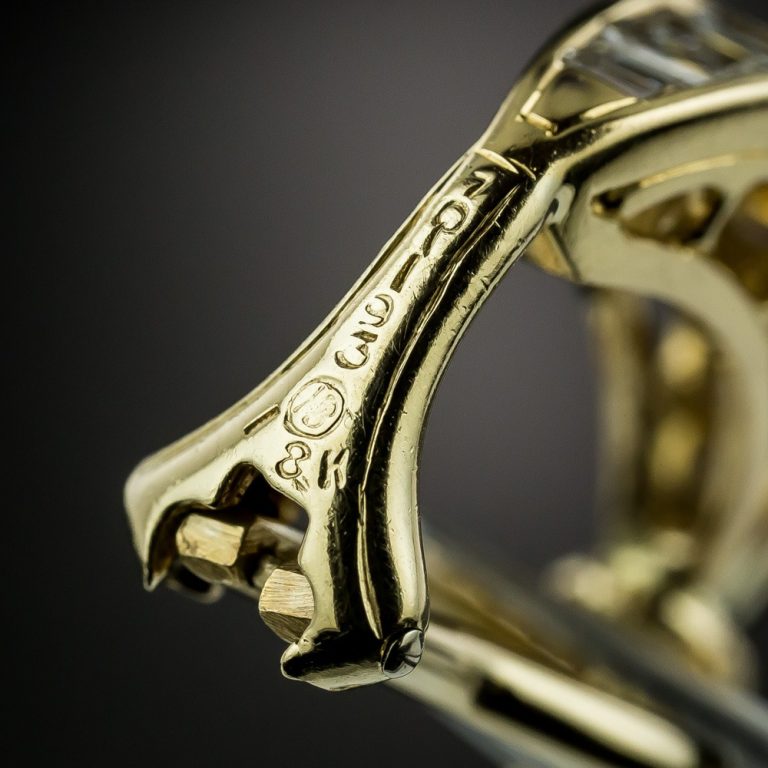
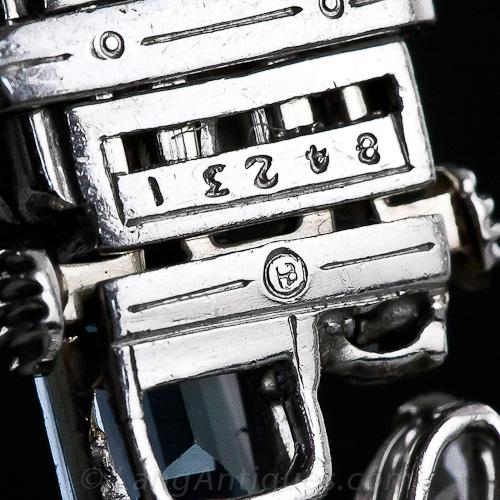


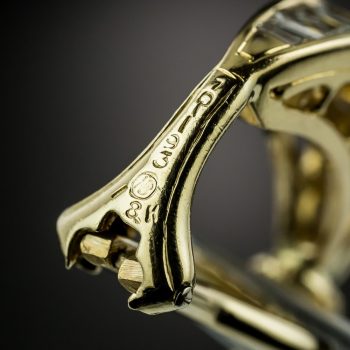
Oscar Heyman and Bros.
| Country | |
|---|---|
| City | New York NY |
| Symbol | circle |
| Shape | circle |
| Era | c.1915, c.1922, c.1934, c.1950, e.1912, c.1943 |
Specialties
- Handcrafted, signed and numbered jewelry pieces.
- Unique and esoteric gemstones and phenomenal gems, cut and polished in their own workshop.
1901
- Oscar and Nathan apprenticed with their great-uncle in Kharkiv, a believed workmaster for Faberge..
1906
- Oscar & Nathan moved to New York.
- Skilled in platinum work, they were uniquely trained and highly desirable and became known as “The Jewelers’ Jeweler.”
1909
- Oscar went to work for the newly opened Cartier, New York.
1911
- The rest of the Heyman family arrives in New York City.
1912
- Oscar Heyman & Brothers (Oscar, Nathan & Harry) opened at 47 Maiden Lane.
- Supplied high-quality platinum jewelry to the trade.
Jeweler’s Jeweler for:
- Cartier
- Van Cleef & Arpels
- Marcus & Co.
- Tiffany & Co.
1916-1942
- Secured 7 patents including:
- Secure invisible bracelet clasp.
- Security pin for double-clip brooches.
- Nearly exclusive US supplier of invisibly set jewels to Van Cleef & Arpels.
- Die stamping machine
1920
- The firm moves to 71 Nassau St and Louis and William join the family business.
1922
- To increase proximity to their jeweler clients they move to 48 W. 40th St.
1933
- The firm begins to buy Columbian emeralds directly from the mine.
1936
- The firm makes a move to 642 Fifth Ave. and Oscar joins a consortium to purchase the Crown of the Andes.
1939
- Oscar Heyman & Bros. begins an affiliation with Van Cleef & Arpels.
1942
- Bombsights and jeweled bearings for the war effort are produced in their workshop.
1964
- In affiliation with the Linde Star Company, they designed the commemorative necklace for the New York World’s Fair.
1969
- Created the necklace for Cartier to highlight the Taylor-Burton Diamond.
- Relocation to 501 Madison Ave.
1970
- Death of Oscar Heyman.
Today:
- Oscar Heyman & Bros. remains a family-run operation employing many relatives of the original team.
JCK:
- c.1934: 58 W. 40th St. New York NY
- c.1943 – c. 1950: 642 Fifth Ave. New York NY