
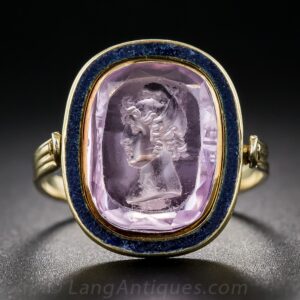
Topaz is an aluminum, hydroxyl-fluorine silicate, found primarily in gem pegmatites. Minas Gerais in Brazil is the largest producer of topaz. A common, yet mistaken belief is that all topaz is yellow. It is most commonly colorless, but natural colors include varieties of blue, pale green, and the spectrum of yellow through sherry orange to pink, and most uniquely, red. Topaz is renowned for its ability to form huge crystals. There is a topaz crystal in the Smithsonian weighing 156 pounds.
High-energy irradiation of colorless topaz, followed by moderate heat, produces blue stones with stable color. Natural blue topaz appears to be created in the same way, so there is no way to differentiate between natural blue topaz and artificially irradiated blue topaz. However, highly saturated natural blue topaz is unknown, so it can be presumed that all deep blue-colored topaz is artificially produced.
Recently another treatment was developed for topaz that produces the “mystic” varieties. These multi-colored “iridescent” stones are created by coating the pavilion facets of colorless topaz with a similar coating used on iridescent sunglasses. Azotich Coating Technology holds the patent.
A Brief History of Topaz
Topaz has been known since ancient times. Examples of topaz ornaments have been found in Egyptian tombs and Roman ruins. The early source for topaz was Ceylon (Sri Lanka), which continues to supply topaz today.
During the Middle Ages, Topaz fell out of favor. It was occasionally used in ecclesiastical jewels but little else. In the 18th century, it became increasingly popular in Spain and France. By the Victorian Era, its use was widespread. Topaz is currently one of the most popular gems used in contemporary jewelry.
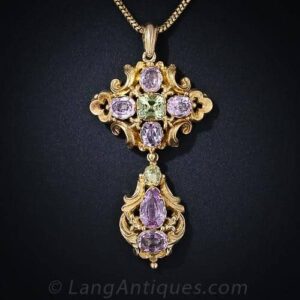
The mining of topaz is strongly associated with tin mining, a mineral needed to create bronze (an alloy of copper and tin) and it is almost certain that the people in the Middle-Eastern Bronze Age would have known about this gemstone.1 In Europe, the stone became highly popular after the topaz discoveries in Brazil during the 18th century and by the turn of the 19th century, yellow and pink topaz were all the fashion and were extensively used throughout most of the 1800s. Although open à jour settings were employed since the end of the 17th century, most topaz was still set in closed-back settings with a back foil to intensify their hue. This was especially true when several stones were set in a cluster or when a complete rivière was to be crafted, as the foil helped create matching colored stones. For smaller individual stones, as used in regard jewelry from around 1840, this was not deemed necessary. Topaz was used to represent the letter T, in either pink or yellow colors.
Topaz is a gemstone that, throughout history, has shared its name with all other yellow gemstones. It was not until the mid-18th century that the name was assigned to the aluminum fluor-silicate that is uniquely topaz. During the 16th century, Cellini described a (most probably) yellow sapphire as “topaz”. Due to its close resemblance in color to citrine, yellow to orange “actual topaz” were termed “precious topaz” to distinguish between them. Topaz comes in many hues, from colorless to yellow, blue, brown, red, and everything in between. The colorless and pale blue stones are most abundant in nature, followed by yellow and brown stones, while the golden-orange, pinks, and reds are most rare. The latter are mostly mined in Brazil.
Topaz Symbolism
Golden topaz is the birthstone for November and blue topaz is an alternative birthstone for December. It is associated with the sign of Capricorn. Topaz commemorates the 4th and 23rd anniversaries.
Topaz Colors
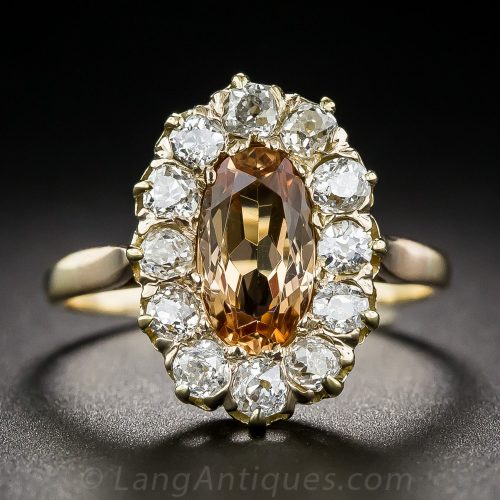
One particular color – or color range – is of special interest to collectors. It is the saturated golden-sherry or quince-jelly hue (often with a brown modifier) and yellow or pink undertones that are referred to as “Imperial Topaz”. How the “Imperial” demarcation came about is subject to speculation with two theories most commonly vying for naming rites. The first theory purports that “Imperial Topaz” was named to honor the Russian Tsar who owned the Ural mountain Topaz mines, reserving the best quality topaz for the emperor and his family. A second version attributes the name “Imperial Topaz” to the Brazilian Empire. Brazilian/Portuguese Emperor Peter II visited the town of Ouro Preto in 1881 and was presented with a reddish topaz by Professor Henry Gorceix, from that time forward reddish topaz was termed “Imperial”. Topaz sellers freely use the term “Imperial” to refer to any topaz with a hint of red or orange, it really only applies to the saturated colors of a small range in hues.
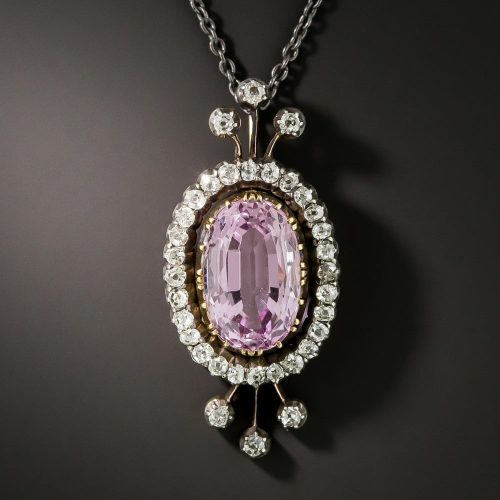
Pink topaz does exist in nature, but it is rare and mostly pale in color. In order to improve the color, these stones were pinked by foiling them with a red foil.2 Colorless topaz was also treated in this fashion.3 Another way of pinking topaz is through the slow heating of yellow stones, up to temperatures of 500 degrees Celsius, followed by slow cooling. The latter method has been practiced since the 18th century and one can safely assume that most pink topaz has gone through one of these treatments.
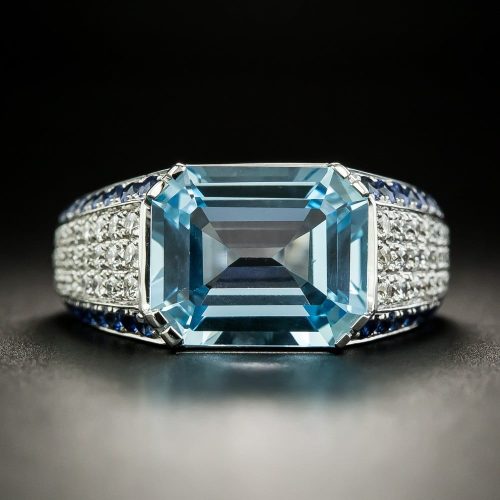
Many of the blue topaz that we see in jewelry today have undergone an irradiation treatment to produce a stable color of varying saturation. The lighter shades are termed sky blue, the medium-range Swiss blue and the darker-toned blue topaz are sold as London blue. White topaz is readily available and has a high luster. They are so clear that they were described as water drops by the Brazilian miners. The Portuguese – who owned the mines – termed them slaves’ diamond in reference to the slaves who worked the mines in the region around Ouro Preto.
Etymology
The name Topaz is derived from the island Topazus, just off the coast of Egypt. It is the same island where the best peridots were historically mined (present-day Zagbargad). The word topaz comes from the Troglodytae language, an ancient Ethiopian tribe, and means to seek due to the fact that the island was always covered in a fog.
Physical Characteristics of Topaz
Topaz is a relatively hard stone, harder than quartz but softer than corundum, which makes it suitable for jewelry. This gem, however, suffers from a perfect cleavage in one direction (the basal plane) so it is a stone that must be handled with some care. A hard knock in the right – or wrong, depending on which viewpoint you take – direction will split the stone in half. In this regard, it is in good company as diamond likewise suffers from directional cleavage. Colorless and blue stones are usually cut with the table a few degrees off this cleavage direction so they can hold a good polish. The more costly imperial topazes are cut with the cleavage plane perpendicular to the table of the gemstone, mostly for weight retention of the rough material which can be very costly (a multitude of a 100 compared to the price of blue topaz). This poses a problem during the setting of a stone as it can easily break. The wearer should be aware of the cleavage plane and know that it is best not to expose topaz to heat or ultrasonic cleaning.